Smooth st. Meadow Grass
With its very good resistance to cold, drought tolerance and strong resistance to wear, Smooth-Stalked Meadow Grass is highly suitable for lawns in the temperate part of the world. Smooth-Stalked Meadow Grass spreads with the aid of rhizomes and regenerate lawns which, for example, have been thinned by wear or drought.
Breeding goals are:
-
fine leaves
-
high density
-
good resistance to diseases such as rust, mildew and redeye spot (Helminthosporium poae).
-
good seed quality for faster establishment.
For information on varieties click here
Poa pratensis - a lot of benefits!
- Poa pratensis grows everywhere!
- Very wear tolerant
- Very persistent
- Winter hardy
- Regenerates and closes holes
- Erect leafy growth and easy to mow with a clean cut
- Low amount of clippings and no small lumps on the lawn after mowing (with rotary mower)
- Dense growth
- Height tolerance to mowing height
- Good heat performance
- In older lawns also good drought tolerance
- Perfect partner in mixtures
- Long growing season
- Excellent colour
- Only medium requirement of Nitrogen
- Healthy appearance in North and East
- Unique for sod production and light root zones
- Slow establishment yes - but in mixtures it doesn't matter!
- “Autumn lawn with more Pp”
Poa pratensis is frequently found in the wild, on both mineral and humus-rich soils in northern as well as southern hemispheres. This proves that we are talking about a specie very well adapted to in fact all markets!
No other grass can tolerate wear like Poa pratensis. Every one who has seen the wear treatment trials are convinced about the fantastic regeneration this specie can do. The rhizomes (both long and short) are “sewing” in new plants in all holes. At the same time it seems like that the erect growth of the leaves leads to less “squeezing” and damage of the leaf material and thus a faster regeneration from the established plants.
When we analyse old lawns we nearly always find Poa pratensis (when the mixture has contained Poa pratensis from the beginning of course).
One of the most winter hardy species. Trials in Moscow demonstrated this as the plots of Poa pratensis where still fully intact after 5-6 year!
Because of the rhizomes as mentioned under wear tolerance
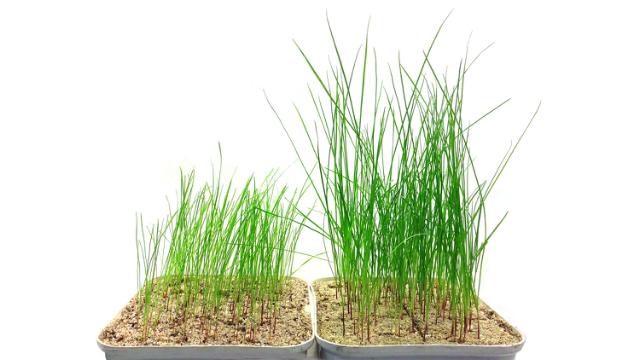
The pictures below illustrates the clean cut you get in Poa pratensis (the left). The leaves of Poa pratensis are growing very upright and are cut very clean.
Added to the clean cut, mentioned above, we also experience a nice “clean” lawn after mowing. The amount of clippings from Poa pratensis is on the level between red fescue and perennial ryegrass but the more stiff leaves and the upright growth means that the clippings more easily drops down between the growing grass and leaves no lumps of wet clippings on the surface.
The good varieties of Poa pratensis like Conni, Broadway and Platini has got a shoot density of app 350 shoots/100 cm2 which is on the level of good turf perennial ryegrasses and above tall fescue. In general we are talking about a nice density.
Poa pratensis can be used in a range of mixtures for various purposes as the tolerance to mowing height is within a large range going from 8-10 mm to 35-40 mm. The only place where Poa pratensis is less suited is for low maintenance areas where mowing is only done a few times per year.
We experience good heat performance i.e. in our trials in south of France with irrigation. This heat performance is also used on i.e. golf fairways in transition zones in China and USA.
The fact that we can always find Poa pratensis in older lawns in areas with summer drought proves that the drought tolerance is quite good. Part of the explanation is that regeneration of the green cover is done from the underground rhizomes when rainfall comes. The grass actually survives very dry periods.
In the north of Europe (and the British Isles) we can see a nice summer performance -even during drought.
The above characteristic with regeneration by the rhizomes in dry areas makes Poa pratensis a very ideal partner for mixtures with tall fescue. Tall fescue stays green during summer whereas the Poa pratensis keeps an improved density in the lawn as well as it keeps the tall fescue a bit finer leaved due to the competition.
In microclover Poa pratensis is one of the best to mix in with the clover.
Poa pratensis is one of the first grasses to start growth in the spring. In seed production it is the very first grass to fertilise due to the early growth. In the autumn it is also growing till late and maintaining a very nice colour.
Most of the times we visit the demo plots at the breeding Poa pratensis is looking very good with a lush green colour. Within varieties we are able to offer varieties from the lighter green colour like Compact to the darker green ones like Broadway and Platini.
The requirement of Nitrogen is lower than for perennial ryegrass although it is not as low as for fine fescues.
Two of the most serious diseases in North of Europe - namely Fusarium nivale (snow mould) and red thread is not really doing Poa pratense any harm and thus leaving the turf healthy and green.
The very good root structure including the rhizomes is binding light root zone mixtures (stadiums, tees etc) very well together. In sod production Poa pratensis is an essential partner to keep the sod together. The only alternative here is to use netting instead which is a more expensive and complicated way!
Poa pratensis is always evaluated in pure stand and the slow establishment is commented. The appearance of Poa pratensis in older lawns never the less proves that it gets established and develops over the first years!
The only place where fast establishment really matters is in sod production where a certain content of Poa pratensis is wanted already one year after sowing. In normal mixtures a content of 15-30% of Poa pratensis is securing a proper content later in the lawn.
In the late summer the conditions for establishment of Poa pratensis is the very best. Soil temperature is high and moisture is sufficient. At the same time – if talking about overseeding – the competition from the old grass is less.
To the top